
Listening First: The Relationship Architecture of PR
Part 7 of The Intentional Visibility Project: An 8-Part Series on Strategic Visibility for Accomplished Women Over 50
Previously: In Part 6, we explored the Tried & New process—how discerning content curation becomes an act of self-reclamation. You’ve gathered your wisdom, curated your mixtape, and now you’re ready to share it strategically. That’s where relationship architecture comes in.
In 1938, Margaret Woodward—the first woman advertising executive—said something that’s still true today:
“Advertising is what you pay for, publicity is what you pray for.”
Eighty-seven years later, that distinction still holds. But here’s what has also remained constant across nearly a century of radical change: the fundamentals of how relationships are built are the same.
Platforms change. Algorithms shift. Technology evolves. But the architecture of building genuine relationships with people who serve the audiences you want to reach? That’s remained remarkably stable.
This matters because when you build strategic visibility on foundations that do not change, you’re not starting over with each seismic shift. You’re building upon that foundation.
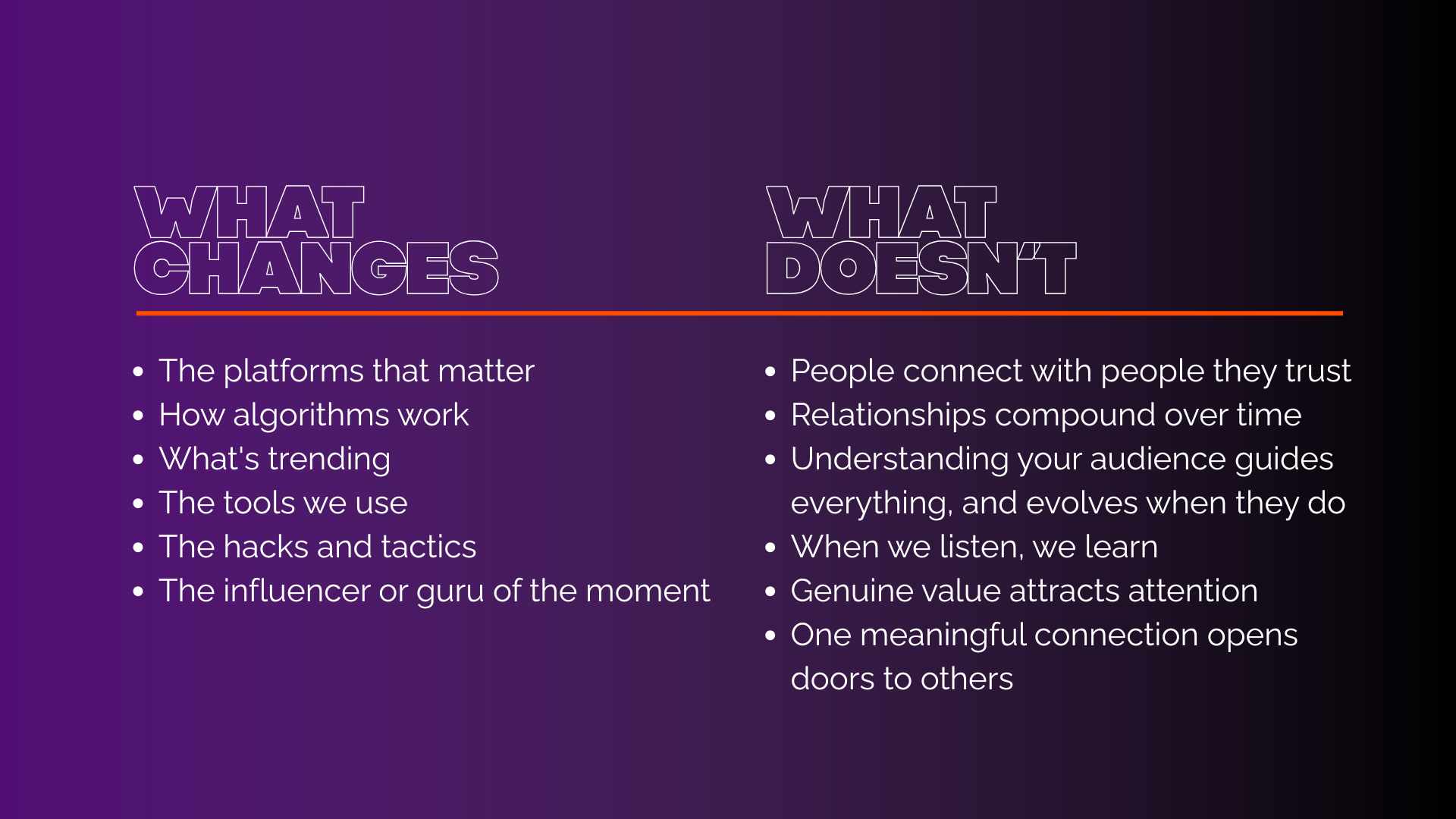
What Actually Changes vs. What Doesn’t
I’ve watched visibility strategies come and go. I built the first phase of my business on Twitter. Now I no longer have an account. I went all in on Blab, then it was gone overnight. I built complex listening systems in Hootsuite, and I’ve pretty much stopped using social media management tools. I keep up with tools and tech, but the tactics change constantly. The platforms rise and fall. The “must-do” advice shifts daily, maybe even hourly.
Approaching PR and media relationships from what doesn’t change builds something that doesn’t need rebuilding.
Two Different Approaches
There are essentially two ways to approach PR and media opportunities.
The first approach focuses on volume and speed. Create a pitch template. Send it to 100 podcasts. Land a few interviews. Share each one once. Move on to the next batch. Repeat.
It’s exhausting and transactional. I have followed the conversations and reports based on what journalists want for years. It’s always the same things: for the people and agencies pitching them to understand the topics they cover, to pay attention to deadlines, to be prepared to be interviewed, and to be kind.
That last one gets me every time; it proves that most people have no idea what PR actually is. They consider it to be free advertising and do not even factor in the value of building a relationship with someone who sits at the helm of the curated audiences they want to meet.
But there is a different approach, one that leads with a warm introduction and thought about how you might make their job easier. They might be excited to introduce you to their audience AND their friends and colleagues who could open more doors for you.
The second approach is slower. It requires more thought. And it produces results that compound for years.
I’m not saying the first approach is wrong. It’s short-sighted.
The Four-Year Client
Let me tell you about a podcast interview I did that was still landing me clients four years after it was recorded.
Not because it went viral or because the podcast had millions of listeners.
Because I kept it in circulation. I repurposed it into multiple pieces of content over time. I tagged the host and let her know that I valued her show and our conversation. I intentionally talked about topics that would last for a while, even though the topic was Twitter strategies. I treated that one 45-minute conversation as a piece of content architecture, not a one-time appearance. The host even repurposed it into a Summer of Social Media where she featured highlights of four interviews.
That’s what happens when you build with what doesn’t change: relationships, understanding, consistent value over time.
One Interview, Years of Value
When someone lands a podcast interview, I often see them record the episode, wait for it to air, share it once on social media, and move on.
There’s another way.
The same interview can become:
- A transcript you repeatedly mine for content ideas
- Multiple social media posts scheduled over months
- Blog articles that expand on topics discussed
- Email sequences to your own audience
- Quotes and soundbites for future use
- Expanded into a workshop or a series of articles—like this
- Reference material for future pitches
- Ongoing conversation with the host’s audience
- Relationship maintenance with the host themselves
One 45-minute conversation becomes months of content. More importantly, it becomes an ongoing thread in your relationship architecture.
This isn’t about “getting more mileage” out of the interview. It’s about recognizing that the conversation you had contains insights worth revisiting, audiences worth staying connected to, and relationships worth maintaining.
That four-year client? They found me because I’d scheduled a post about that interview to go out long after most people would have forgotten about it. The relationship with that audience was still alive because I’d kept it alive.
What Listening Actually Reveals
Remember the Brain Trust process from the audience article? This is where it extends beyond just understanding your audience to understanding the ecosystem they’re part of.

When you listen to podcast hosts, you hear:
- What topics resonate most with their audience
- The types of guests that create the best conversations
- The topics their listeners get excited about
- What gaps might exist in their coverage and whether you can provide a different POV
When you listen to event planners, you notice:
- What themes they’re building events around
- The communities they’re serving
- The speakers their audiences respond to and what else these speakers are up to
- What problems they’re trying to solve, or dreams they help deliver
- How they structure their events to stand out and create unique experiences
When you pay attention to media outlets, you see:
- What stories they’re following
- The angles they’re exploring
- The experts and sources they feature and trust
- What their readers care about and respond to
This intelligence gathering isn’t about manipulation. It’s about understanding so you can show up as a genuine resource when the timing is right.
So many people are seeking the quick fix or the hack. All along, this is what works, regardless of industry or level of business.
Partnership Rather Than Pitch
Here’s what shifts when you approach PR this way:
- Podcast hosts become partners in serving audiences you both care about, rather than gatekeepers you need to convince.
- Event planners become collaborators building valuable experiences, rather than decision-makers you need to impress.
- Journalists become colleagues with deadlines and needs, rather than intimidating figures you’re trying to crack.
- Authors and speakers become potential collaborators who serve similar audiences, rather than competitors to outshine.
- Community leaders become co-creators of value, rather than exclusive clubs to break into.
The energy changes entirely. You’re not performing or pushing. You’re connecting and contributing.
Where to Begin
If this approach resonates, start with one podcast. Not ten. Not fifty. One.
Listen to several recent episodes. Notice what the host cares about. Pay attention to their audience’s responses. Understand what makes a great conversation on that show.
Then, when you reach out, you’re not sending a template. You’re starting a conversation based on genuine understanding.
If you land the interview, approach it as the beginning of a relationship, not the completion of a task:
- Show up prepared and generous
- Make the host’s job easy
- Deliver real value to their audience
- Get the transcript
- Create content from it over time
- Keep the conversation going
- Be someone they’ll remember
One strategic relationship built with care creates more lasting visibility than a hundred random pitches ever could.
The Integration, Not the Add-On
This connects to everything we’ve covered in this series:
- Your PR work builds on your intentionality (Part 1)—you know why these relationships matter to your larger purpose.
- It adds to your architecture (Part 2)—each relationship becomes part of a foundation that strengthens over time.
- It requires your audience understanding (Part 3)—you can’t build strategic media relationships without knowing who you’re trying to reach.
- It demonstrates how wisdom meets AI (Part 4)—AI can help you find opportunities and repurpose content, but the relationship building is distinctly human.
- Your interviews become part of your content mixtape (Part 5)—curated thoughtfully into your larger story.
- Through Tried & New (Part 6)—every appearance becomes content you can build with for years.
PR isn’t separate from your content strategy or your visibility architecture. It’s woven throughout.
And in our final article, we’ll connect all these dots to show you how these seven pieces create your strategic compass—the navigation system that guides every decision about where to show up, what to share, and how to build visibility that lasts.
This is Part 7 of The Intentional Visibility Project, an 8-part series exploring the strategic architecture of lasting visibility for accomplished women over 50.
Previously: Discerning Content Curation: Start with What’s Tried & New — Part 6
Next and final in the series: Connecting the Dots: How Strategy Becomes Your Compass — Part 8, where we bring together all seven pieces to show you how they create your strategic navigation system.

Donna Cravotta is founder of Cravotta Media Group, host of The Real 50 Over 50 livestream, and creator of BeVisible.club. She guides accomplished entrepreneurial women 50+ as they architect strategic visibility that matches the significance of their work.
Newsletter | The Real 50 Over 50 | The Intentional Visibility Project on Substack



0 Comments